Just a little bit more - and we will live.
Soon leave, summer. And the real life will begin.
But the problems at work, the relatives decided to unexpectedly arrive, then three extra kilograms ... And a new, happy life does not come.
One girl is waiting for the prince on a white horse, her mother dreams of becoming a professional bridge player, a young man dreams of leaving for Switzerland, a married couple believes that for happiness they lack their own nest.
And all to happiness - a stone's throw. The bright future is looming on the horizon.
You can leave - far away and for a long time. Forever. But, wherever their destiny takes them, they always take with them their fears, doubts, disappointments, themselves.
Time flows through your fingers, but nothing changes. But, it seems, the only thing that will facilitate their existence and vomit from a vicious circle is death.
Funerals are the only thing that can bring diversity to their lives. But they begin to happen with disappointing regularity.
These people are our friends, our neighbors, passers-by, whom we see hundreds every day. And, maybe, it is we ourselves?
Pack your bags, dear friends.
"It's so scary when someone leaves, and you stay."
The past goes away irrevocably. I want to return it, remember all that was so expensive once.
Evgeny Grishkovets puts on a sailor's cap and remembers his three years of military service in the Pacific Fleet.
The story will go both about the school where he studied, and about the long journey by train to the destination, and about how scared he was of the unknown.
He talks simply and frankly, but with the smallest details. And the main thing is precisely these minor details, in which the air of time and the moments of his youth are enclosed.
In the service, he yearned for home, dreamed of returning from the Far East sooner. He went away as a boy, a recent schoolboy, but returned as an adult, a patriot of the Soviet country.
In the play there is a lot of humor, funny absurdities and funny tales. For example, about how he allegedly defeated the Japanese pilot. But there are serious stories about the heroism of our sailors, about the fate of his generation.
"... And you are not offended. Because you still do not know how to be offended, because as soon as you learn to be offended, at the same second, not the next, and at the same second you will learn to offend ... "
How much does love cost.
Everything is sold and everything is bought. Everything has a price. Everyone has a price. The market economy has penetrated into the world of human relations.
He sold his dream. And what did you want to become as a child? A cosmonaut, a cook, a fireman, a teacher? Most likely, they chose noble professions.
And he so dreamed of becoming a scientist! Represented himself in the ghostly light of a laboratory with a test tube in his hand. In a dream, I dreamed of science.
But it was necessary to keep an old father. Therefore I had to serve not the science, but the state. In the end, to become a policeman is to work for the benefit of society.
Now the father is dead. Empty apartment is covered with dusty furniture. Here it is, an inheritance. All that remains of a loved one. It's time to appreciate everything.
But, the more the appraiser lingers, considering the price, the clearer it is that how much is past and present, successes and failures.
Three hammer blows. Sales!
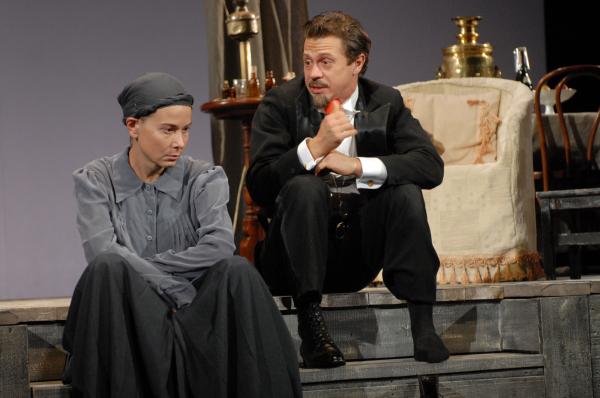
"Seagull" A.P. Chekhov is widely popular and is often staged in theaters of the capital. In the production of Dainius Kazlauskas, the main emphasis is not on the history of the actress, unlucky, like many Chekhovian heroes, in love, but selflessly devoted to her acting role. On the contrary, the author puts Konstantin Treplev - unrequitedly in love with the writer.
Lacking affection from the narcissist mother-actress, who could not find peace, even in the glory that came to him as a writer, heard a refusal from the one he had long and faithfully loved, Treplev decides that for him there is no more reason to live in this world.
A fatal decision, an irreversible act ... The end of life, the end of fate ...
You are responsible for those who have tamed.
A good person will not abandon a friend in need, even a dog.
Poor artists, grandfather and his grandson give short presentations to the rich inhabitants of the Crimean dachas. The old man once took a little boy to be brought up by a drinking cobbler.
But they are thrown very little money, sometimes even a trained poodle has nothing to feed. They have no other income.
Funny tricks and jumps through the hoop of a white fluffy dog are rejoiced by rich children in fancy suits on their shoulders. And the old man twists an ancient barrel organ that plays a dull German waltz.
One day a boy ran out of a luxurious house, tried by parents and servants. But he was capricious, and then he wanted to see a street performance with a poodle.
The dog liked the barchuk so much that he asked his mother to buy it. Stamping with your feet!
The artists gave up a lot of money. Soon a messenger from that family came to them and once again asked to sell the poodle. I was upset that I did not persuade my grandfather and the boy.
And then the poodle disappeared. Will a disconsolate boy find a four-legged friend?
Betray friends - the last thing, worse than nowhere.
Which is better - to condemn the innocent or to justify the offender?
Each juror must ask such a question.
They must decide on the fate of a young guy from a poor family.
He is accused of murdering his father, and he does not plead guilty. Could he have committed this terrible crime?
How little time! And you need to understand in detail the testimony of witnesses. Neighbors do not cause trust. Some of them could be mistaken.
Men fiercely argue, even shout at each other.
It is extremely difficult to come to a single point of view - they are too different in age, education, life experience and character.
The performance amazes with the heat of passion and excellent acting.
Twelve pieces of paper, twelve chances to kill a man ... Or save?
Thriller with cabbage filling.
Once in the KVN I heard American blues about Little Red Riding Hood. Since then, I am smiling at her mention ...
This, of course, what should be a brave girl to scratch one. Through the forest. Yes, and with pies. Nobody argues, granny is sacred. But, it seems, Mama does not care at all that her wolf can take a snack.
But then went to a psychological thriller. A sophisticated assassin (besides a wolf) cunningly tries to find out the path for the girl and ... even a patty, a bastard, begged.
Eats the grandmother entirely (just imagine now the size of this monster - the grandmother something to swallow), but the further attention ... disguises (!) In her clothes and remains to wait for the Hood ...
In my opinion, the poor girl is waiting for a big surprise, after she "pulls the string."
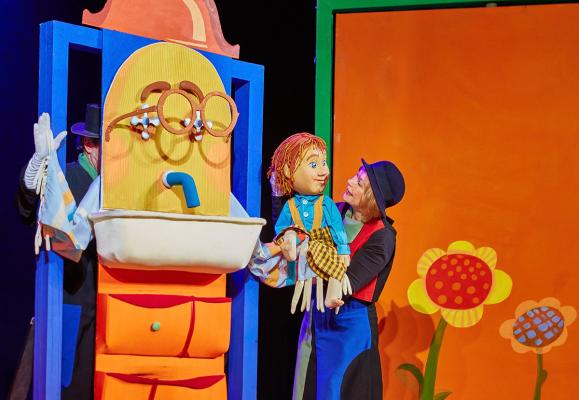
Are you ready to please the child with a bright and juicy, musical and very funny fairy tale "Little Red Riding Hood"?
Sing songs with all your favorite Hats, think about how to outwit an evil wolf and save a grandmother. And recharge the most radiant energy of this wonderful musical.
"It's all the same, for whom to marry, the main thing is to marry."
And so all the suitors do not have enough. And if the girl is ugly?
It's a fixable thing, if you are a princess! Papa the king will think of something.
The princess's father is waiting for the suitors. The doors of the palace are open to them.
The most charming and gay prankster decided to play the next groom. She changed into a servant girl, and forced her maid to pretend to be a lady of royal blood.
But the groom turned out to be a gay princess, who so bravely skates on rollerblades! They behaved just like children! He talked with her and legs, and crawled along the roofs, and played stupid servants.
She chose her as her husband.
And at the wedding, a miracle happened! Unattractive princess became a beauty.
Just many years ago, she was bewitched. The groom fell in love with her good heart and she changed. Only the princess's aunt knew this secret.
A kind and cheerful English fairy tale with songs and dances from the witty author of the story about Winnie the Pooh.
An unusual story of an ordinary family.
Children have long grown up and fled from the parent's nest. What can collect all family members in their home? Mysterious disappearance of the father!
Three daughters and three of their beloved come to the aid of the mother to find the head of the family - a teacher and part-time poet. He is an elderly alcoholic, very well-read and educated.
Once he gave his beloved wife a collection of poems, she told him - three children.
But in search of their father they find a heap of family secrets, a tangle of mutual claims and grievances.
Close-up shows the love of loved ones. But not simple, warm, warming the soul. A special love of cultural and educated people. Love with a touch of snobbery.
It turns out that there can be too much love. Now they understand why they bought houses at a distance from each other. Just to not suffocate from this mutual feeling.
They say "I love you", read "you have to love me", the phrase "I missed you" means "you owe me for my love."
It's amazing how much interesting things can be hidden behind other people's doors.
Do you think that you know yourself and have completely taken place in your life? Try to spend a week with all members of your family.
Oliver Sachs was a neuropsychologist and worked all his life with people suffering from various disorders and abnormalities: who stopped feeling his body, who curses and twitches without end, and someone, perhaps, does not even recognize his wife and accepts his hat! ..
But, probably, the world would never know about the incredible tricks that his brain can make with a man if Oliver Sachs did not have one more important talent - the ability to beautifully and breathtakingly describe all that he had seen as a doctor. Yes, he was a writer. According to his book, this performance was staged.
Freaks, crazy, strange, awkward people - all the characters here are special. They are touching and touching in their attempts to master this world, to understand which glove should be worn on which hand ...
This is the deep human message of the play, partly ironic, a little sad, but certainly kind, calling us to observe special people simultaneously and with the impartial position of the curious scientist, and from the deeply experienced, compassionate person.
Here Hamlet wanders around the stage with a volume in his hand. He, the actor giving a presentation in Elsinore, the prince only on the stage. But, as befits an actor, Hamlet lives his role to the end. So, learning that the present king, Hamlet's uncle, treacherously killed his brother-king, Hamlet's father, in order to deceive the throne, Hamlet decides to take revenge on his uncle. In his decision, however, he is not sure, and he constantly fluctuates between the notorious "to be" and "not to be," and only in the final, dying, dares to pierce his uncle with a deadly rapier.
So, the story line is true to the Shakespearean text, full of questions and insoluble mysteries. However, the fact that Hamlet is actually a lyceum and fulfills his role without parting with the book makes it possible to say that one truly Shakespearian problem is particularly prominently displayed and grotesquely explicated in the production: do we choose the role that we will play? If not, can we even stage it, arrange accents, creatively beat events, scenery, costumes? Or all that remains for us is to act, frantically giving in to the fact that we live, and asking as little as possible about the question, but who has invented all this, if, say, we fell for revenge for our father and die in the finale of our tragedy?